
Compare speech production costs per approved minute under the same script, voice, language and acceptance requirements. Include subscriptions, paid seats, billed usage, retries, editing and qualified language review. Use a cost worksheet and demand scenarios to evaluate the workload before treating a headline subscription price as your production budget.
What is the right unit for speech costs?
The useful buying unit is an approved minute: audio that meets your delivery standard and can be used in the intended project. Input characters describe submitted text. Generated minutes describe output produced. Neither tells you how much acceptable narration your team actually receives.
Keep all three measures in the worksheet. A script can generate different durations at different speaking speeds, and rejected attempts can consume usage without increasing approved output. Count an accepted passage once, even if it appears in several internal review files.
Define approval before collecting prices. Specify correct wording, pronunciation, pace, delivery format and authorized use. If the required deliverable is audio only, confirm that the selected workflow can provide that output. Do not use the cost of a broader finished presentation as if it were a directly equivalent speech quote.
Which workload assumptions must stay constant?
Create a workload specification that accompanies every quote and pilot. Use one approved script version and a representative language mix. Include difficult names, numbers and terminology when they occur in ordinary production; a deliberately easy script can understate review effort.
| Workload variable | Keep constant | Your specification |
|---|---|---|
| Script | Approved wording and character count | [ ] |
| Language and voice | Language, pronunciation needs and authorized voice source | [ ] |
| Delivery | Target pace, duration range and audio format | [ ] |
| Acceptance | Named reviewer and objective pass conditions | [ ] |
| Demand | Approved minutes and deadline by period | [ ] |
| Scope | Audio only, or explicitly allocated mixed-media work | [ ] |
Do not force identical duration when doing so would make one language unnatural. State a permitted delivery range and use actual approved minutes in the final calculation. Keep the intended message and quality standard equivalent.
Separate recurring narration from one-time setup. Voice preparation, pronunciation decisions and script cleanup may affect the first month differently from later production. Preserve those costs in the purchase decision, even when you report recurring delivery economics separately.
Which charges belong in the comparison?
Include costs required to deliver the specified workload: subscription commitment, paid seats, incremental usage, billed retries, post-production and qualified review. Use actual billing evidence or a dated quote. For AKOOL, consult current plan terms and confirm the applicable account configuration.
Keep cash commitment separate from cost allocation. An annual agreement may be displayed as a monthly equivalent while requiring a larger commitment. Record payment timing, currency and taxes. Specify whether tax is included, excluded or unrecoverable in your internal comparison.
Count included usage and top-ups once. If a subscription already pays for the allowance used by the task, do not add a second notional usage charge to the cash total. Record consumed units for capacity planning, and add only actual additional purchases to cash cost.
Before accepting a quote, ask for the billing unit, allowance, retry treatment, expiry or rollover conditions, required access and commercial-use terms. Record concurrency or throughput conditions relevant to deadlines. Mark an unanswered item “unconfirmed”; do not substitute a general product description. Use AKOOL billing guidance to locate account-specific information.
How do you calculate cost per approved minute?
Divide total attributable speech production cost by approved output minutes for the same period. Keep a separate view of marginal spend when deciding whether to take on one extra task.
Cost per approved minute = (allocated fixed fees + additional usage purchases + production and review labor + other attributable charges) ÷ approved minutes.
| Worksheet input | How to record it | Your input |
|---|---|---|
| Fixed fees and paid seats | Allocate once using a stated rule | [ ] |
| Additional usage | Top-ups or overages actually purchased beyond included allowance | [ ] |
| Retries | Record units and charges; exclude charges already counted above | [ ] |
| Editing | Hours × loaded hourly cost | [ ] |
| Language review | Qualified reviewer hours × hourly cost | [ ] |
| Other charges | Necessary delivery or rights costs not counted elsewhere | [ ] |
| Approved minutes | Accepted output duration, counted once | [ ] |
| Normalized result | Total attributable cost ÷ approved minutes | [ ] |
For shared subscriptions, choose a defensible allocation rule before comparing results. You could allocate by tracked usage or reserved capacity, provided you apply the same rule every period. Show both the allocated speech cost and the full subscription obligation so a small allocation does not hide a large purchase.
If no output passes review, report zero approved minutes and an undefined cost per approved minute. Do not divide by generated duration to create an apparently successful result. Investigate the rejected output and retain its spend in the project record.
What changes when a team scales?
Test low, expected and peak demand with the same acceptance standard. The following figures are entirely hypothetical USD planning inputs, excluding tax. They are not AKOOL prices, account quotes or observed performance. Fixed fees include seats; the usage column contains incremental purchases only.
| Input | Low | Expected | Peak | Your input |
|---|---|---|---|---|
| Approved minutes | 20 | 60 | 120 | [ ] |
| Generated minutes, including retries | 30 | 84 | 192 | [ ] |
| Allocated fixed fees | 80 | 80 | 80 | [ ] |
| Additional usage purchases | 0 | 40 | 160 | [ ] |
| Editing: hours × $30 | 1 × 30 = 30 | 2 × 30 = 60 | 5 × 30 = 150 | [ ] |
| Review: hours × $40 | 1 × 40 = 40 | 3 × 40 = 120 | 8 × 40 = 320 | [ ] |
| Total attributable cost | 150 | 300 | 710 | [ ] |
| Cost per approved minute | $7.50 | $5.00 | $5.92 | [ ] |
In this illustration, expected demand spreads the fixed allocation over more approved output. Peak demand raises retry and review effort, so normalized cost rises again. No scenario establishes a generally cheaper option.
Record unused allowances separately from cash cost. They may explain poor utilization, but they are not another fee. Check whether peak volume fits the quoted allowance, available concurrency and review staffing. A lower calculated unit cost is not useful if the approved audio arrives after its deadline.
How should AKOOL be evaluated for this workload?
Validate one representative speech task in the selected account before relying on the budget. AKOOL’s presenter input guidance describes script-based speech and prerecorded audio inputs. That documentation does not establish an audio-only export, an applicable voice rate or standalone parity for your task.
Confirm the available voice settings, output route, billing unit, allowance, concurrency and intended commercial use. Request clarification where account terms are incomplete. Keep those fields unverified until supported by account evidence or a written quote.
Use a pilot acceptance log with script version, selected voice, submitted units, generated duration, billed units, pronunciation findings, pacing findings, export checks and approved duration. Record reviewer time as work occurs. No matched workload test or account quote is presented here.
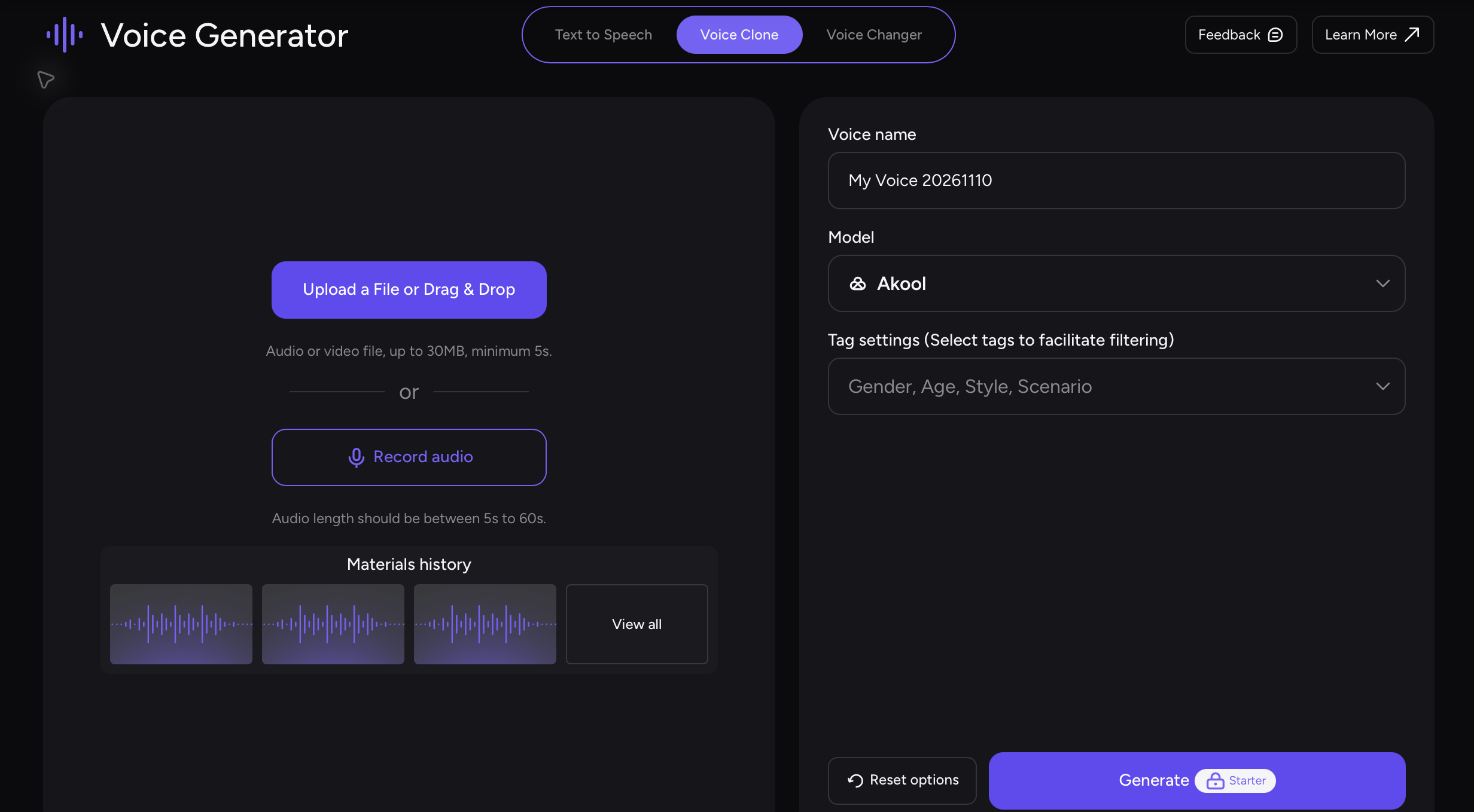
A broader subscription may be worthwhile when your team has real, budgeted demand for its other capabilities. Allocate that value explicitly rather than assuming every included feature replaces an existing expense. Review current AKOOL terms, then cost one representative speech task.