




How BrainGlitch Is Building Cinematic Worlds With AKOOL
AKOOL Creator Case Study | Mukhtar Luthfi · BrainGlitch (MLuth.Films)
Indonesian AI filmmaker Mukhtar Luthfi turned a fascination with generative AI into BrainGlitch, a cinematic storytelling brand built around primal survival, monstrous creatures, and relentless short-form action. Using Seedance 2.5 on AKOOL, he is creating visually ambitious films that would traditionally require actors, locations, creature design, VFX teams, and significant production budgets — entirely on his own. One featured survival film reached 17 million views on Instagram and another 2 million views on X.
From AI Marketing Content to AI Filmmaking
Mukhtar Luthfi didn't originally set out to become an AI filmmaker.
Based in Indonesia and creating under the name BrainGlitch (MLuth.Films), Mukhtar first began experimenting with generative AI for affiliate marketing, creating AI-generated UGC-style content designed to promote products. But the deeper he went into generative tools, the more he saw something beyond their marketing applications: a way to make the films he had previously only been able to imagine.

Instead of using AI simply to generate individual assets or promotional clips, Mukhtar started treating it as a filmmaking medium — one capable of helping an independent creator construct characters, environments, creatures, action sequences, and entire fictional worlds without a traditional production team.
“I realized AI let me explore my imagination freely and actually build the films and worlds I pictured in my head — bringing my own imagined stories to life.”
That realization became BrainGlitch. Today, Mukhtar creates short-form cinematic AI films set in a distinctive fictional universe where primitive humans struggle to survive alongside enormous, dangerous creatures. His work blends survival cinema, epic fantasy, creature features, and found-footage energy.
Visually, the style is deliberately unusual. Mukhtar combines ultra-photorealistic environments, believable anatomy and lighting, and polished cinematic fantasy imagery with the aggressive handheld movement and imperfect texture of early-2000s MiniDV documentary footage. The result feels both cinematic and immediate — as though someone with a handheld camera somehow found themselves documenting an impossible prehistoric world.
The Challenge: Creating a World That Never Existed
The ambition behind BrainGlitch creates an obvious production challenge. These aren't simple talking-head videos or isolated AI-generated shots. Mukhtar's stories involve primitive settlements, enormous creatures, complex environments, fights, escapes, rescues, and rapidly changing action. A single short can require numerous characters and creatures to appear convincingly across multiple shots while the camera continuously changes position.
Because the films are designed for short-form platforms, there is very little time to establish the world. Every second has to do something. Mukhtar intentionally structures his videos so the intensity continues to build as the story progresses. Camera angles change every few seconds. The action escalates. New threats appear. The viewer is continually given another reason to keep watching.
A comparable live-action production could require location scouting, actors, costumes, creature designers, stunt coordination, camera crews, extensive visual effects, post-production, and a substantial budget. For Mukhtar, the challenge became translating the complexity of the world in his imagination into AI-generated video without sacrificing the pacing, visual specificity, or cinematic style that makes BrainGlitch recognizable.
Building the BrainGlitch Workflow
Mukhtar's process begins before he generates a single frame of video. First comes the idea. Rather than allowing the AI model to dictate the story, he starts with his own concept and builds outward from there. He develops the characters and creatures, then creates character sheets to help establish how they should look throughout the film.
Consistency matters because BrainGlitch isn't built around isolated AI clips. Mukhtar is trying to tell stories.
Once the visual foundation is established, he begins constructing individual scenes. His prompts can become extremely detailed, describing not just what appears in a scene, but how the scene should behave: characters, creatures, environment, movement, camera position, pacing, atmosphere, lighting, and overall mood.
For a creator whose visual identity depends on specificity, that level of control is essential. It is also what made Seedance 2.5 on AKOOL particularly interesting to him.
Discovering AKOOL Through Creator Clash
Mukhtar first came to AKOOL through another creator. A friend invited him to participate in AKOOL Creator Clash, and the challenge aligned naturally with the kind of cinematic storytelling he was already trying to create.
Once he began working inside AKOOL, one seemingly technical feature became especially important to his workflow: the ability to use prompts of up to 15,000 characters.
For many creators, a larger prompt box might seem like a small product detail. For Mukhtar, it changed how much of his vision he could communicate to the model. His scenes often contain multiple layers of information — character appearance, creature behavior, environmental detail, camera movement, shot composition, lighting, timing, atmosphere, and action. Compressing all of that into a short prompt can mean deciding which details to sacrifice.
“What I like most is the freedom to be detailed. The prompt limit of up to 15,000 characters is much larger than what most tools offer, so I can fully describe my scenes — characters, creatures, camera, timing, and mood — without cutting anything down.”
That additional room gave Mukhtar the ability to treat prompting less like issuing a short command and more like writing instructions for a scene.
Using Seedance 2.5 as a Cinematic Tool
Seedance 2.5 quickly became Mukhtar's preferred model on AKOOL. One reason is its ability to produce the kind of multi-shot visual coverage his storytelling style depends on.
BrainGlitch films rarely stay visually static for long. Mukhtar likes rapid changes in perspective and camera angle, aggressive handheld movement, and real-time pacing. The viewer might move from a close-up to a wide environmental shot to a creature attack within seconds. That variety creates momentum.
According to Mukhtar, Seedance 2.5 has been particularly effective at interpreting the detailed instructions behind those scenes while producing clean outputs with relatively few errors.
“The output from Seedance 2.5 on AKOOL is very clean — minimal errors and closely matched to what I actually want.”
That matters beyond image quality. Every failed generation costs an independent creator time. When a model misunderstands a scene, loses an important detail, or requires repeated attempts to approximate the intended shot, production slows down. For Mukhtar, being able to communicate more information in the original prompt — and then have the model interpret that information more closely — means spending less time fighting the AI and more time building the film.
Once his scenes are generated, he brings the footage into CapCut, where he assembles the shots and completes the final edit.
His workflow is lean: Idea → character and creature development → detailed scene prompting → Seedance 2.5 generation on AKOOL → editing and assembly in CapCut → publishing.
Behind that simple workflow is something that would have been extraordinarily complicated only a few years ago: a single creator effectively directing an entire fantasy production from a computer.
The Film That Reached Millions
One BrainGlitch survival film demonstrates just how far that workflow can go. The film drops viewers into Mukhtar's signature world — a place where primitive humans aren't simply surviving the environment; they're surviving alongside monstrous creatures.
The short combines the ingredients that have come to define his work: immediate danger, creature-driven spectacle, rapid visual storytelling, cinematic environments, and an escalating sense that something even bigger may happen in the next few seconds.
Then audiences found it.
The film reached 17 million views on Instagram. On X, it generated another 2 million views — 19 million views across the two platforms.
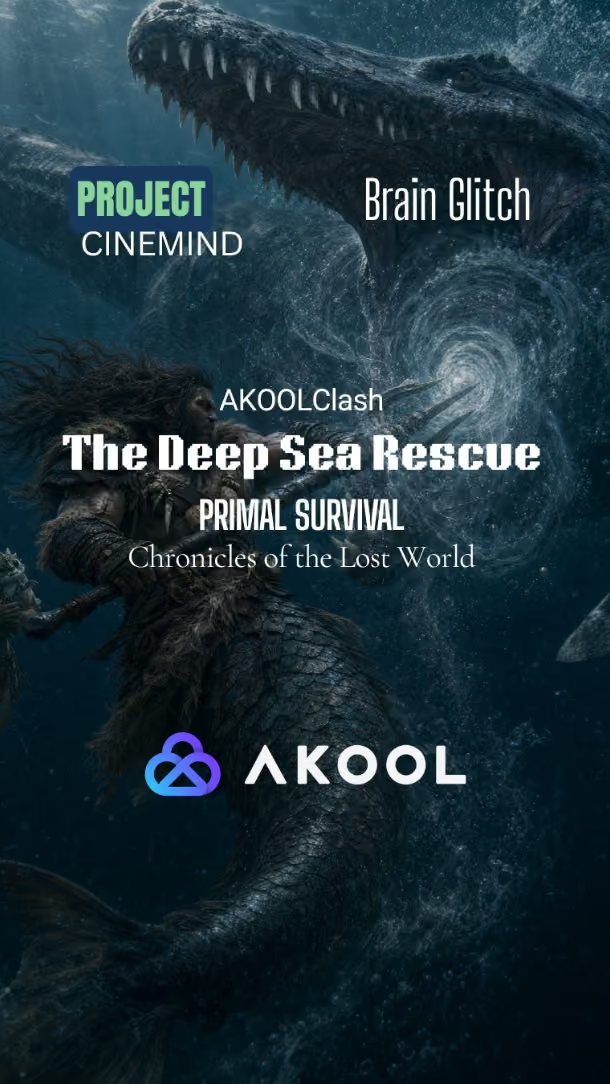
For an independent creator working without a conventional film crew or studio production infrastructure, those numbers represented more than a viral moment. They demonstrated that an individual filmmaker could create the type of visually ambitious concept that once required an enormous production apparatus and distribute it directly to a global audience.
Mukhtar has seen several of the videos he has made with AKOOL go viral, helping his accounts grow across Instagram, TikTok, X, and Facebook. His Instagram community has grown to more than 150,000 followers.
Replacing Production Scale With Creative Scale
The most significant impact of AI on Mukhtar's workflow isn't simply that it makes video generation faster. It's what he is now able to attempt.
Consider what it would take to recreate a BrainGlitch survival film traditionally: performers, costumes and makeup, locations or constructed sets, creature concepts and 3D models, animation and visual effects, cameras and lighting, production crews, and post-production. For an independent creator, the cost alone could make the idea unrealistic.
“With AKOOL, I created one of these short films entirely on my own. Producing something at that cinematic level, solo and in a fraction of the time, simply wouldn't have been possible for me with a traditional workflow.”
AI doesn't remove the creative decisions behind the film. Mukhtar still has to invent the world, develop the characters, decide what happens, design the visual language, construct detailed prompts, choose successful generations, determine pacing, edit the footage, and understand what will hold an audience's attention.
What changes is the scale of what one person can execute. Instead of limiting the story to what can realistically be filmed, Mukhtar can begin with the story he wants to tell and work backward. A giant creature doesn't have to be removed because there is no VFX budget. An elaborate environment doesn't have to be simplified because there is no location. A new camera angle doesn't require resetting an entire production.
A Distinctive Style Matters More as AI Gets Better
Mukhtar's success also points to something increasingly important about AI-generated content. Access to powerful models is becoming easier, which means access to the technology itself is less likely to be what separates one creator from another. Taste, storytelling, and recognizable creative identity become more important.
BrainGlitch is a strong example. Mukhtar isn't simply generating technically impressive footage. His work has developed recognizable creative rules: primitive survival, monstrous creatures, escalating danger, rapid multi-shot storytelling, aggressive handheld movement, photorealistic environments, a semi-anime epic-fantasy sensibility, and a rough MiniDV-inspired texture layered over cinematic imagery.
Those choices create an identity viewers can begin to recognize independent of the underlying model.
“Find your own style and stay consistent with it, because a recognizable visual identity is what makes your work stand out.”
Learning to Direct AI
Mukhtar also believes creators shouldn't expect the technology to eliminate experimentation. His advice is to learn how to communicate with the models. Detailed prompting has become a core part of his craft, but it developed through iteration rather than instant mastery.
“Don't expect perfection on the first try; treat every generation as learning.”
For Mukhtar, prompting is not simply a technical skill. It is part of the creative process. Every additional detail gives shape to something that previously existed only in the creator's imagination — a character, a camera movement, a creature, a landscape, an entire world.
“Every word you write is boundless imagination taking shape.”
That philosophy is visible throughout BrainGlitch. AI provides the production capability, but the idea still has to come from somewhere.
What BrainGlitch Shows About the Future of Independent Filmmaking
Mukhtar's journey began with AI-generated affiliate content. It evolved into something much bigger: an independent filmmaker creating original cinematic worlds for millions of viewers.
His experience reflects a broader shift across creative production. The question is no longer simply whether AI can generate an impressive video clip. Creators are beginning to ask whether they can use these systems repeatedly — to establish characters, develop recognizable worlds, control visual language, tell stories, and build audiences around original intellectual property.
Mukhtar is already experimenting with that future. With Seedance 2.5 on AKOOL, he can move from an imagined survival sequence to generated footage, edit the results himself, publish directly to audiences around the world, and immediately learn from how those audiences respond.
No studio. No massive VFX team. No traditional production budget.
One creator, an idea, and a new kind of filmmaking toolkit.
For BrainGlitch, that combination has already produced films seen millions of times.
“In this world there are no limits — only your imagination is the limit.”
Creator Snapshot
Creator: Mukhtar Luthfi — BrainGlitch / MLuth.Films
Location: Indonesia
Instagram: @brain.glitch_ml — 150K+ followers
Platforms: Instagram, TikTok, X, and Facebook
Primary AKOOL model: Seedance 2.5
Workflow: Concept → Character Sheets → Detailed Prompting → Seedance 2.5 on AKOOL → CapCut → Social Distribution
Featured results: 17M Instagram views + 2M X views = 19M+ combined views
Featured project: https://www.instagram.com/reel/Db8W97zvf3D