
AI film festivals are becoming a major destination for filmmakers experimenting with generative video, AI assisted production, and new forms of visual storytelling. In 2026, the landscape includes independent festivals, established creative programs, and large platform led competitions from companies such as AKOOL, PixVerse, Higgsfield, and Runway.
As of September 2026, several major competitions have already closed, while the AKOOL AI Film Challenge and PixLight 2026 are still accepting entries. This guide compares the current AI film competition landscape and explains how filmmakers can prepare a strong entry, with a closer look at the AKOOL AI Film Challenge, which remains open until November 20, 2026.
AI Film Festivals and Competitions in 2026 at a Glance
AI film competitions vary widely. Creators should compare prizes, deadlines, runtime, tool requirements, and submission rules before starting production.
| Competition | 2026 Status | Deadline | Headline Prize or Rewards | Format | AI Tool Requirement |
|---|---|---|---|---|---|
| AKOOL AI Film Challenge | Open | Nov. 20, 2026 | $500,000 in Creator Rewards* | 3 creative categories | AKOOL must be meaningfully used |
| PixLight 2026 | Open | Oct. 9, 2026 | $300,000 prize pool | 3 to 20 minute pilot or screenplay track | PixVerse Canvas required for Pilot workflow |
| Higgsfield Global Film Festival | Closed | Sep. 16, 2026 | $1,000,000 cash pool | 3 minute minimum film | AI video and image generation inside Higgsfield |
| Runway AI Festival 2026 | Completed | Apr. 27, 2026 | Film Grand Prix: $50,000 plus credits | 3 to 15 minute narrative film | Generative video required |
| Reply AI Film Festival 2026 | Completed | 2026 edition concluded | International AI short film competition | Short film | AI generated or AI enhanced workflow |
*Subject to AKOOL eligibility requirements, qualification criteria, program limits, and Official Rules.
The comparison shows a broader trend. The creative platform is increasingly part of the competition format. That makes tool eligibility almost as important as genre, runtime, or prize money.
AI Film Competitions Still Open in 2026
For filmmakers looking for a current opportunity, two notable competitions remain open in late September: the AKOOL AI Film Challenge and PixLight 2026.
AKOOL AI Film Challenge: Open Until November 20
The AKOOL AI Film Challenge is designed around a simple creative premise: make films that become possible because of AI.
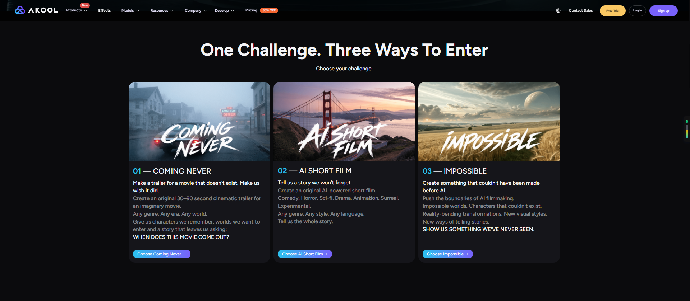
Rather than forcing every creator into the same format, AKOOL offers three ways to enter.
COMING NEVER asks filmmakers to create an original 30 to 90 second cinematic trailer for a movie that does not exist. The goal is not simply to show impressive shots. Creators need to establish a world, characters, and a premise strong enough to make viewers want the full film.
AI SHORT FILM is for complete AI powered stories. Entries can span comedy, horror, science fiction, drama, animation, surreal work, experimental filmmaking, and other styles or languages.
IMPOSSIBLE focuses on concepts that could not realistically have been created before AI. These might include impossible worlds, transformations, unusual characters, new visual styles, or storytelling ideas that conventional production would struggle to realize.
Across the three categories, qualifying entries are eligible for the overall awards. The Challenge promotes $500,000 in Creator Rewards. Qualified entries may also receive a $100 Creator Reward, subject to eligibility requirements and program limits.
The judging criteria make the creative priorities clear. Story carries the largest weighting, followed by Originality, Creative Execution, Use of AKOOL, and the “I’d Watch That” Factor.
The implication is simple. A collection of beautiful AI shots is not enough. A strong entry also needs a compelling hook, narrative progression, a memorable idea, and polished execution.
The Challenge opened in September, submissions close November 20, 2026, and winners are scheduled to be announced on December 5.
Enter the AKOOL AI Film Challenge
PixLight 2026: Open Until October 9
PixVerse takes a different approach with PixLight 2026. Its competition includes a Pilot Track for longer genre films and a Script Track for screenplay development.
For creators deciding between current competitions, format is one of the clearest differences. PixLight is oriented toward longer pilot development, while AKOOL offers three creative routes, including a short trailer format for filmmakers who want to communicate a cinematic concept without producing a longer film.
What Other AI Film Festivals Reveal About the Industry
Major competitions that have already closed are still useful references because they show what the AI filmmaking ecosystem increasingly values.
The Higgsfield Global Film Festival offered a large cash prize pool and required longer film submissions. AI video and image generation was closely tied to the Higgsfield creative ecosystem.
Runway’s AI Festival expanded beyond film into areas including New Media, Gaming, Design, Advertising, and Fashion. Its Film category emphasized complete narrative work using generative video.
Reply’s 2026 AI Film Festival also demonstrated the increasingly international nature of the category, with thousands of short film submissions from creators around the world.
Together, these programs point toward the same shift. AI filmmaking competitions are moving beyond demonstrations of what a model can generate. Story, originality, editing, sound, visual continuity, and intentional creative direction are becoming more important.
How Does the AKOOL AI Film Challenge Compare?
The AKOOL AI Film Challenge is particularly relevant for creators who want flexibility in both format and workflow.
First, the three category structure supports different levels of production ambition. A creator can build a concise fictional trailer through COMING NEVER, develop a complete narrative through AI SHORT FILM, or focus on experimental ideas through IMPOSSIBLE.
This gives filmmakers an alternative to competitions that require several minutes of finished narrative content.
Second, other creative tools can be part of the workflow as long as AKOOL is meaningfully used in the final creation.
That matters because modern AI filmmaking is often a multi model process. One model may be better for a specific establishing shot, another for motion, and another for a particular reference driven scene. AKOOL’s AI Video Generator gives creators access to models including Sora, Veo, Kling, Seedance, and others within one workspace.
Third, the judging system makes storytelling explicit. Story receives the highest individual weighting. The competition therefore rewards what the film communicates, not simply how technically complex the generation process was.
How to Enter the AKOOL AI Film Challenge
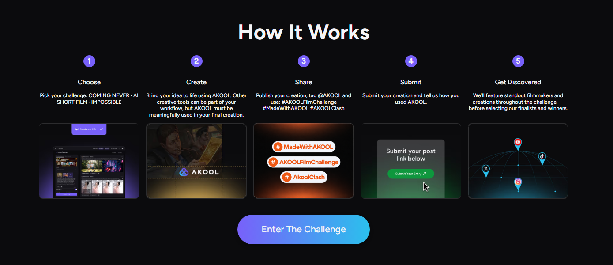
The submission workflow can be reduced to five practical steps.
1. Choose the Right Category
Start with the idea, then select the category that best supports it.
Choose COMING NEVER if the concept works as a high impact movie trailer. Choose AI SHORT FILM if you have a complete narrative. Choose IMPOSSIBLE if the central attraction is a world, transformation, visual idea, or storytelling approach that AI makes newly possible.
2. Build the Film Around a Clear Story
Before generating scenes, define the hook.
What happens? Who or what does the viewer care about? What changes between the first shot and the final moment?
For a longer film, it helps to break the concept into individual scenes before generation begins. AKOOL’s guide on directing a full AI video with a multi scene workflow explains how to plan scenes, choose models for different shots, review continuity, and refine individual parts of a larger sequence.
Creators who need more structure at the planning stage can also follow the prompt guidelines for AI video to define the goal, inputs, creative direction, visual style, constraints, and expected outputs before generation begins.
3. Use AKOOL Meaningfully
AKOOL must play a meaningful role in the finished work, although other creative tools may also be used.
Think about the production scene by scene. Different shots may require different models or workflows.
Continuity also matters. If a character appears across several scenes, changes in face, clothing, proportions, or style can quickly break immersion. Creators working with recurring characters or visual references can use a reference to video workflow for consistent characters and visual styles to give the generation process clearer visual anchors.
4. Publish and Prepare the Submission
AKOOL asks creators to publish their work, tag @AKOOL, and use the required Challenge hashtags.
The current application also asks creators to make the work publicly available on supported social platforms and explain how AKOOL contributed to the creation process.
Because submission requirements may differ by category, creators should review the latest Challenge page and Official Rules before publishing the final version.
5. Submit Before November 20
Leave enough time for final rendering, sound checks, social publishing, links, and form completion.
A strong film can still become ineligible if its submission package is incomplete.
Submit Your Film to the AKOOL AI Film Challenge
How to Make an AI Film Competition Entry Stronger
A few production principles apply across most AI film festivals.
Start with one clear idea. A short film does not need a complicated plot, but it needs a reason to keep watching.
Build scene by scene. Short generations are usually easier to control than trying to create an entire film in one generation. Plan the establishing shot, important character moments, conflict, transitions, and final payoff separately.
Protect visual continuity. Keep characters, clothing, lighting, locations, and art direction consistent across scenes.
Edit aggressively. Remove shots that look impressive but do not help the story. Strong pacing is often more valuable than adding another visual effect.
Treat sound as part of the film. Music, dialogue, ambience, sound effects, and silence all influence whether a sequence feels cinematic.
Most importantly, use AI to expand the creative idea. The strongest competition entries are not simply videos that look AI generated. They use AI because the story benefits from possibilities that would otherwise be difficult to create.
AI Film Festival Submission Checklist
Before entering an AI film competition, confirm:
- Submission deadline and timezone
- Eligibility and age requirements
- Film length and accepted format
- Required AI platform or models
- Whether other AI and editing tools are permitted
- Public posting and hashtag requirements
- AI use disclosure requirements
- Music, likeness, trademark, and third party IP rights
- Subtitle and language requirements
- Required logos, credits, or other branding
- Application form, synopsis, project links, and team details
Create the Film Only AI Can Imagine
AI film festivals in 2026 show how quickly generative video is developing into a serious creative medium. The competitions attracting attention are no longer rewarding technical novelty alone. They increasingly ask filmmakers to combine AI with story, direction, editing, sound, and a clear creative point of view.
For creators looking for a current competition, the AKOOL AI Film Challenge remains open until November 20, 2026. With three entry categories and $500,000 in Creator Rewards promoted across the Challenge, filmmakers have several ways to turn an AI powered idea into a competition entry.
Choose your category, develop the story, use AKOOL meaningfully in the finished work, and submit before the deadline.