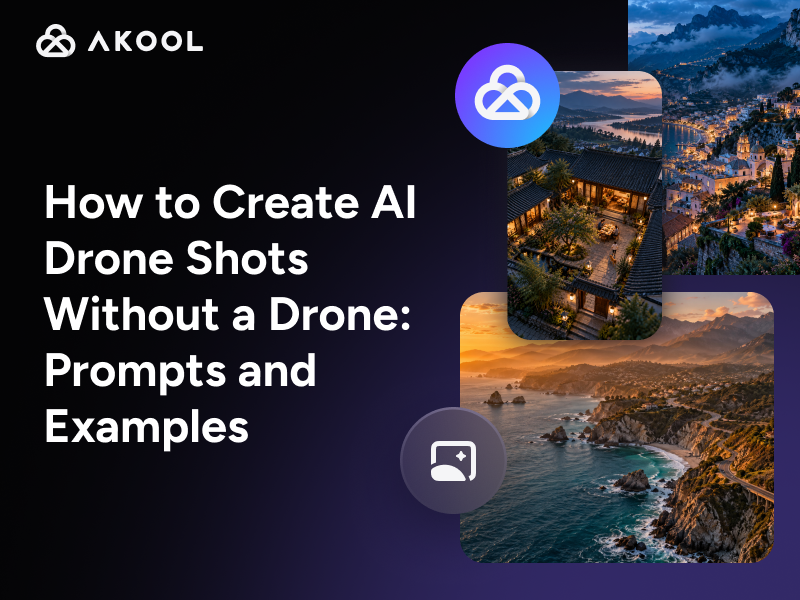
You can create a drone-style shot by describing a high camera angle, clear subject, camera path, and scene movement in a text-to-video prompt, or by animating a reference image. The result is synthetic video, not footage captured above a real location, so it should not be presented as evidence of what a real place looks like.
What is an AI drone shot?
An AI drone shot is a synthetic video designed to look as if a camera were flying above or around a scene. It can imitate top-down, flyover, orbit, and descending aerial moves, but no physical drone recorded the resulting footage.
That distinction matters.
A real drone records a real landscape at a particular place and time. A drone shot AI workflow generates or transforms pixels based on your prompt and references. Buildings, roads, coastlines, vegetation, and even terrain can therefore change during the shot.
AI aerial footage works well when the goal is visual communication rather than factual documentation. You might use it for a fictional establishing shot, a storyboard, an ad mood scene, or an early creative concept.
You should not use a generated aerial shot to imply that a real hotel has a specific ocean view, that a property contains an amenity it does not have, or that a recorded event actually happened at that location.
How do you create a drone-style video in AKOOL?
Use the normal AI video workflow: choose a current video model, start from text or an image, describe one aerial camera path, generate the clip, inspect the geography, then revise the specific instability you see.
AKOOL's current generator supports prompts, images, footage, and reference-driven workflows across multiple video models. Its public model page currently includes Veo 3.1, Kling 3.0, Seedance, Sora, Wan, and other video models.
There is no need for a dedicated drone preset.
1. Choose the input
Use text-to-video when the location can be fictional and you want the model to design the scene.
Use image-to-video when the appearance of a building, landscape, product, or composition needs a stronger visual anchor. AKOOL's current Image-to-Video workflow lets you upload an image, select a compatible model, add a motion prompt, and generate from that starting frame.
2. Pick a current model
Choose a model exposed in the current AKOOL interface. Do not assume that every model supports the same inputs, duration, resolution, audio, or reference controls.
For this article, test at least Veo 3.1 and Kling 3.0 because both are currently listed in AKOOL's video workspace and are relevant candidates for camera-motion tests. This is a test plan, not a claim that either model is universally better for aerial shots.
3. Describe one camera path
Avoid:
Epic cinematic drone camera flying everywhere over a huge beautiful city.
Prefer:
High aerial camera glides forward at constant altitude above a fictional coastal road. Keep the horizon level and the road geometry stable. One continuous shot with no cuts or sudden zoom.
The prompt gives the model a path it can attempt to maintain.
4. Generate and inspect geography
Look beyond whether the clip feels cinematic.
Check whether buildings stay in place, roads preserve their shape, mountains remain on the same horizon, and the subject keeps the same proportions while the camera moves.
5. Revise one failure at a time
If the horizon tilts, add “maintain a level horizon.”
If buildings change, reduce camera distance or use an image reference.
If the landscape transforms during a long move, shorten the clip or simplify the flight path.
Screenshot required before publication: current AKOOL model selector with the selected aerial-test model visible.
Screenshot required before publication: current prompt/input area showing either text-to-video or the uploaded image used in the test.
What prompts work for overhead, flyover, and orbit shots?
The three paths below solve different visual problems.
| Camera path | Camera behavior | Good for | Main failure to inspect |
|---|---|---|---|
| Top-down reveal | High camera descends toward one point | Markets, courtyards, architecture, maps | Buildings move or change shape |
| Forward flyover | Camera moves forward at stable altitude | Roads, landscapes, travel concepts | Horizon or terrain morphs |
| Circular orbit | Camera circles a fixed subject | Buildings, monuments, product-scale architecture | Center object deforms |
Top-down reveal
A top-down reveal works best when one central subject anchors the composition while the camera changes altitude.
Prompt
One continuous aerial top-down shot over a fictional coastal market at sunrise. Camera begins high and descends slowly toward a central courtyard. Buildings remain fixed in place; gentle crowd movement, warm light, no cuts or text.
Shot diagram in words
High vertical view
↓
Slow controlled descent
↓
Central courtyard grows larger
↓
Camera remains pointed downward
Original AKOOL clip
- Model: Veo 3.1
- Input: Text-to-video
- Duration: 8 seconds
- Aspect ratio: 16:9
- Output quality: 1080p for the comparison test; test 4K separately if needed
- Camera instruction: Slow vertical descent, no rotation
- Audio: None required
- Recommended attempts: 3
Failure fix
If rooflines or streets shift during the descent:
Keep all building footprints, streets and roof shapes fixed. Reduce the descent distance. Camera remains directly overhead with no rotation.
The purpose of the revision is not to add more style. It reduces degrees of freedom.
Forward flyover
A forward flyover works best when the camera follows one readable direction and the horizon remains stable.
Prompt
Drone-style camera glides forward above a fictional mountain road, maintaining a steady altitude and level horizon. Pines pass beneath the camera while distant peaks remain stable. One smooth 7-second shot, no cuts and no sudden zoom.
Shot diagram in words
Camera faces forward
→
Constant forward travel
→
Road stays near center
→
Horizon stays level
Original AKOOL clip
- Model: Kling 3.0
- Input: Text-to-video
- Duration: 8 seconds as the normalized comparison target, if exposed by the current selector
- Fallback duration: Nearest current option at or below 10 seconds
- Aspect ratio: 16:9
- Output quality: 1080p
- Camera instruction: Steady forward glide, constant altitude
- Audio: No audio required
- Recommended attempts: 3
Failure fix
If the mountain geometry changes:
Simplify the distant landscape. Maintain one mountain ridge throughout the shot. Reduce forward camera speed. Keep the road shape and horizon unchanged.
Circular orbit
An aerial orbit keeps one subject centered while the camera travels around it. The center object is the part most worth protecting.
Prompt
Aerial camera makes a slow clockwise orbit around a glass pavilion on a hill. Keep the pavilion centered and unchanged while the valley rotates in the background. Golden hour, single continuous shot.
Shot diagram in words
Pavilion remains at center
↻
Camera travels clockwise
↻
Background changes perspective
↻
Camera-to-subject distance stays constant
Original AKOOL clip
- Model: Veo 3.1
- Input: Image-to-video
- Reference image: A rights-cleared fictional glass pavilion viewed from an elevated three-quarter angle
- Duration: 8 seconds
- Aspect ratio: 16:9
- Output quality: 1080p initially
- Orbit target: 45 to 60 degrees, not a full 360-degree orbit
- Audio: None
- Recommended attempts: 3
Failure fix
If the pavilion stretches or changes:
Reduce the orbit to 45 degrees. Keep constant distance from the pavilion. Preserve its glass panels, roof shape and proportions exactly. No camera zoom.
For more complex movement, an existing camera-motion clip can sometimes provide stronger guidance than text alone. AKOOL's guide to reference-driven camera control explains the distinction between using text for the subject and a video reference for motion or camera behavior.
Which input works better: text-to-video or image-to-video?
Use text-to-video when visual invention is acceptable. Use image-to-video when the starting location or composition needs to look more like a known reference.
| Requirement | Text-to-video | Image-to-video |
|---|---|---|
| Invent a fictional environment | Strong fit | Requires a source image |
| Preserve one building's appearance | Less controlled | Better starting anchor |
| Define camera motion | Prompt-driven | Prompt plus visual anchor |
| Maintain geography | Can drift substantially | Can still drift as new views are invented |
| Reproduce a real place accurately | Not reliable | Better resemblance, still not factual footage |
| Source rights | Prompt still needs lawful use | You need rights to the uploaded image |
AKOOL describes image-to-video as a way to animate product photos, still images, or renders using a selected video model.
A reference image improves the starting appearance. It does not guarantee that the generated camera move accurately reconstructs unseen sides of a real location.
How do you keep buildings and terrain stable?
Reduce how much the model has to invent during one shot. Simpler geometry, one camera movement, shorter travel distance, and a useful visual reference generally give you fewer opportunities for geography to change.
Five practical rules help:
- Use one movement per shot. Do not combine a descent, orbit, zoom, tilt, and acceleration unless you are deliberately testing complexity.
- Give the frame a clear anchor. A road, pavilion, courtyard, or coastline gives the model a structure to preserve.
- Use an image reference when appearance matters. This reduces uncertainty in the initial scene.
- Limit the movement or duration when drift appears. A shorter orbit may preserve a building better than a full rotation.
- Revise the failure explicitly. “Keep the mountain ridge fixed” is more useful than “make it more realistic.”
Model behavior varies. The same aerial video prompt can preserve geography in one generation and drift in another, which is why this article requires real side-by-side testing rather than an unsupported accuracy percentage.
What are the best uses for AI aerial shots?
AI aerial shots are most useful when the scene is illustrative, fictional, conceptual, or atmospheric rather than documentary evidence.
Concept videos: show what a campaign, destination concept, game world, or future development could feel like.
Product-launch mood scenes: establish scale or atmosphere before cutting to a real product shot.
Storyboards and pre-visualization: communicate an intended crane, overhead, or flyover composition before a physical shoot.
Fictional establishing shots: create invented landscapes, futuristic cities, fantasy environments, or locations that do not need to correspond to reality.
A real drone remains the better tool when the viewer needs to see a real property's exact surroundings, inspect infrastructure, verify a location, document an event, or make a factual claim about what exists on site.
Synthetic aerial imagery can illustrate a place or idea. It should not be presented as verified aerial footage of a real location.
Which AKOOL model and settings should you use?
Do not name one model the best for overhead video without testing the same shot under comparable settings.
AKOOL currently offers multiple video model families through the same generator, and the available inputs and controls vary by model. Its public generator currently lists Veo 3.1 and Kling 3.0 among the available options.
Before publication, run the same aerial prompt through at least two models and record:
| Test | Model A | Model B |
|---|---|---|
| Model/version | Veo 3.1 | Kling 3.0 |
| Quality | 4K output; strong detail and realistic lighting | 4K output; strong motion and texture detail |
| Duration | Up to X seconds | Up to X seconds |
| Aspect ratio | 16:9, 9:16, 1:1 | 16:9, 9:16, 1:1 |
| Attempts | 3 generations; relatively consistent | 3 generations; some variation |
| Building stability | Minor geometry changes in complex structures | Occasional structural distortion |
| Horizon stability | Stable horizon with minor movement | Generally stable; occasional horizon distortion |
| Quality | 4K output; strong detail and realistic lighting | 4K output; strong motion and texture detail |
| Most visible limitation | Small details may flicker or change from frame to frame | Small textures and environmental details may change between frames |
Do not convert this test into an overall model ranking. The useful question is which model handled this camera path and scene with fewer revisions.