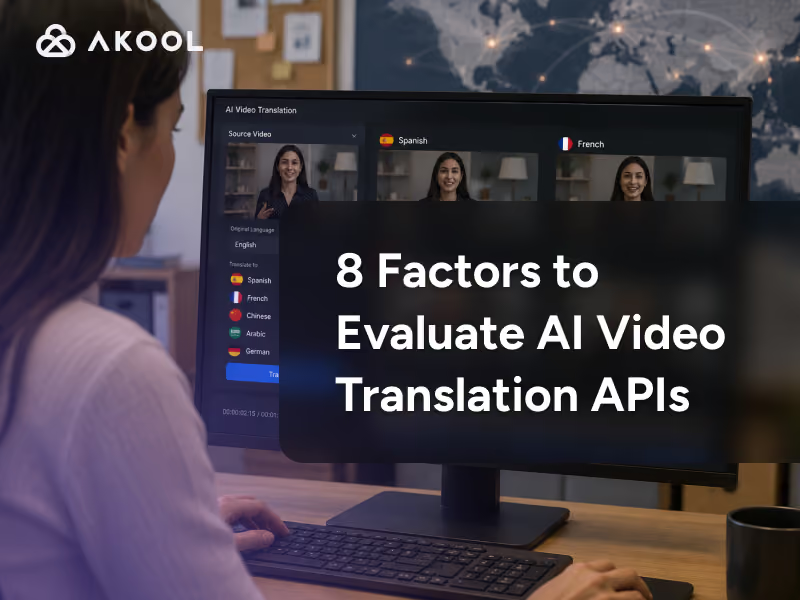

Marketing teams expanding into global markets face a critical decision when selecting an AI video translation API. The wrong choice can mean robotic-sounding dubs, misaligned lip movements, and content that fails to connect with international audiences.
AKOOL delivers neural lip-to-speech synchronization that keeps your translated videos looking natural across 155+ languages. But before committing to any platform, you need to understand what separates a capable API from one that creates more problems than it solves.
This guide breaks down the eight evaluation factors that matter most when choosing an AI video translation API for your multilingual content workflows.
Quick guide: 8 factors for evaluating AI video translation APIs
- Lip sync accuracy: Neural synchronization that matches mouth movements to translated audio
- Language coverage: Support for your target markets with native dialect options
- Voice quality: Natural-sounding synthesis that preserves speaker identity
- API integration: Documentation and SDKs that fit your existing tech stack
- Processing speed: Low-latency pipelines for high-volume production workflows
- Translation accuracy: Context-aware engines that handle industry terminology
- Customization options: Control over voice styles, caption formats, and output settings
- Enterprise readiness: Security compliance, scalability, and dedicated support
How we chose these evaluation criteria
Selecting an AI video translation API requires more than comparing feature checklists. The factors in this guide reflect what enterprise marketing teams and advertising agencies actually need when localizing content at scale.
Each criterion addresses a specific challenge in multilingual video production:
- Lip sync accuracy determines whether your localized videos look professional or awkward to viewers
- Language coverage ensures you can reach all your target markets without switching platforms
- Voice quality affects whether audiences engage with your content or click away
- API integration impacts how quickly your development team can implement the solution
- Processing speed affects your ability to meet campaign deadlines across multiple markets
- Translation accuracy protects your brand message from embarrassing mistranslations
- Customization options let you maintain brand consistency across languages
- Enterprise readiness ensures the platform can grow with your localization needs
8 key factors for evaluating AI video translation APIs
1. AKOOL: Advanced lip sync with neural voice synthesis
AKOOL's Video Translation API uses proprietary diffusion-based models to deliver frame-accurate lip synchronization across 155+ languages. The platform's neural lip-to-speech technology creates photorealistic facial dynamics that match translated audio precisely.
What sets AKOOL apart is the combination of high-fidelity phoneme alignment with multi-speaker detection. The API processes translations through a real-time neural pipeline optimized for enterprise-scale campaigns, handling everything from subtitle generation to voice cloning in a single workflow.
Fortune 500 brands including Coca-Cola, Logitech, and Qatar Airways use AKOOL to localize marketing videos across global markets. The platform has generated over 300 million AI assets for enterprise clients.
AKOOL features
- Neural lip-to-speech synchronization: Photorealistic facial dynamics that match translated audio with precise temporal alignment
- 155+ language support: Comprehensive coverage including regional dialects for localized content
- Voice cloning technology: Preserve your original speaker's identity across every language version
- Multi-speaker detection: Accurate subtitle and translation precision for videos with multiple presenters
- Background music removal: Clean audio separation for clearer voice translation results
- Webhook integration: Receive automated notifications when processing completes
AKOOL pros and cons
Pros:
- Frame-accurate lip sync using diffusion-based models maintains viewer immersion
- Full production suite includes avatar creation, face swap, and video generation alongside translation
- SOC 2 compliant infrastructure meets enterprise security requirements
Cons:
- Advanced features like custom voice training require higher-tier plans
- Maximum video duration of 60 seconds per API call requires batch processing for longer content
- Video file size capped at 300MB means large source files need compression first
2. Rask AI: Minute-based pricing for marketing teams
Rask AI positions itself as a localization platform for marketing departments and content creators who translate recorded footage into new language markets. The platform handles transcription, translation, voice cloning, and dubbing through both a web interface and API.
The collaborative workspace allows team members to review translations before final rendering. This review step catches phrasing issues that automated systems might miss, though it adds time to the production workflow.
Rask AI features
- Voice cloning in 32 languages: Maintains speaker identity across translated versions
- Inline transcript editor: Review and correct translations before generating dubbed audio
- Translation dictionary: Maintain consistent brand terminology across all projects
Rask AI pros and cons
Pros:
- Team collaboration features streamline the review process for multi-person workflows
- API access available for automated production pipelines
- Supports 135+ languages for broad market coverage
Cons:
- Lip sync feature consumes double the minutes from your quota
- Visual alignment shows drift on clips longer than 90 seconds
- Overage rate of $3 per minute can escalate costs quickly for high-volume teams
3. ElevenLabs: Voice realism for audio-focused projects
ElevenLabs produces natural-sounding voice output with breath patterns, micro-pauses, and emotional inflection. The Dubbing Studio interface lets you edit individual segments before regenerating audio, which helps catch mistranslations before they reach viewers.
The platform supports 29 languages for dubbing, covering major European and Asian markets. Teams requiring less common languages will need to evaluate whether this coverage matches their target regions.
ElevenLabs features
- Segment-level editing: Modify individual sections without reprocessing the entire video
- Voice cloning: Preserves speaker identity with natural vocal patterns
- Developer API: Programmatic access for custom pipeline integration
ElevenLabs pros and cons
Pros:
- Natural-sounding audio output with emotional nuance
- Detailed editing controls for fine-tuning translations
- API documentation supports custom workflow development
Cons:
- Only 29 languages supported limits reach in some markets
- No lip sync for video output means you must handle visual alignment separately
- Per-language billing multiplies costs on multi-language projects
4. Deepdub: Emotion-aware synthesis for media production
Deepdub targets film, television, and streaming content where emotional accuracy matters as much as translation accuracy. The platform reads the emotional arc of scenes and adjusts vocal delivery accordingly, producing output that sounds like a performance rather than disconnected text-to-speech segments.
The Deepdub Live product handles real-time dubbing for broadcast applications, serving a niche that few other platforms address.
Deepdub features
- Emotion-aware synthesis: Reads scene context to adjust vocal delivery
- Real-time dubbing: Live broadcast capability for sports and news content
- Pre-cleared voice bank: Licensed voices with legal coverage for commercial use
Deepdub pros and cons
Pros:
- Emotion mapping produces performances rather than flat synthetic output
- Managed service option includes project managers and sound engineers
- Broadcast-grade output quality meets professional standards
Cons:
- Enterprise-only model requires contacting sales to access the platform
- Entry point estimated at $10,000+ per engagement
- Not designed for short-form social media or quick-turnaround content
5. Maestra: Transcription and dubbing in one platform
Maestra bundles transcription, captioning, translation, and dubbing into a single workflow. The platform handles speech-to-text first, then translation, then voice synthesis in sequence. Teams managing subtitles and dubbed versions simultaneously can reduce tool-switching with this integrated approach.
The transcript editing step lets you review translated text before dubbing. Fixing errors at this stage prevents them from appearing in the final audio.
Maestra features
- Integrated workflow: Transcription, translation, and dubbing in one pipeline
- Transcript editing: Review and correct text before voice generation
- WCAG-compliant captions: Accessibility-ready subtitle export alongside dubbing
Maestra pros and cons
Pros:
- Unified workflow eliminates need for separate transcription and dubbing tools
- 80+ language support covers most business localization needs
- Caption and subtitle generation included with dubbing output
Cons:
- Voice quality sits in the middle tier compared to specialized voice platforms
- No lip sync capability for video output
- Per-minute pricing lacks predictable monthly cost structure
Comparison table: AI video translation API evaluation factors
What makes lip sync accuracy critical for video translation?
Lip sync accuracy determines whether your localized video maintains viewer immersion or creates a distracting disconnect between audio and visuals. When mouth movements fail to match spoken words, audiences notice immediately. This breaks the professional appearance of your content and can reduce engagement.
The technical challenge involves matching phonemes (individual speech sounds) to corresponding mouth shapes across different languages. Some platforms use basic audio-to-video alignment that works on short clips but drifts on longer content. Others employ neural networks trained on facial dynamics to generate frame-accurate synchronization.
AKOOL's diffusion-based models achieve 0.02-second facial sync precision. This level of accuracy holds even on videos exceeding ten minutes, where competing platforms typically show visible drift after the first few minutes.
How do you assess translation accuracy for specialized content?
Translation accuracy for specialized content depends on how well the platform handles domain-specific terminology, idiomatic expressions, and cultural context. Automated translation engines that work well for general content can produce errors when processing technical B2B videos, medical content, or industry-specific marketing materials.
Look for platforms that offer custom glossary support. This feature lets you define how specific terms should be translated, ensuring brand names, product terminology, and industry jargon appear consistently across all language versions.
AKOOL's Video Translation API includes studio voice controls that let you specify words that should not be translated and define fixed translations for specific terms. This level of control prevents the mistranslation errors that can embarrass your brand in target markets.
Why AKOOL delivers the most complete video translation API
AKOOL earns the top position because no other platform combines neural lip sync accuracy, 155+ language support, voice cloning, and enterprise security in a single API. The diffusion-based models produce photorealistic facial dynamics that competing platforms cannot match.
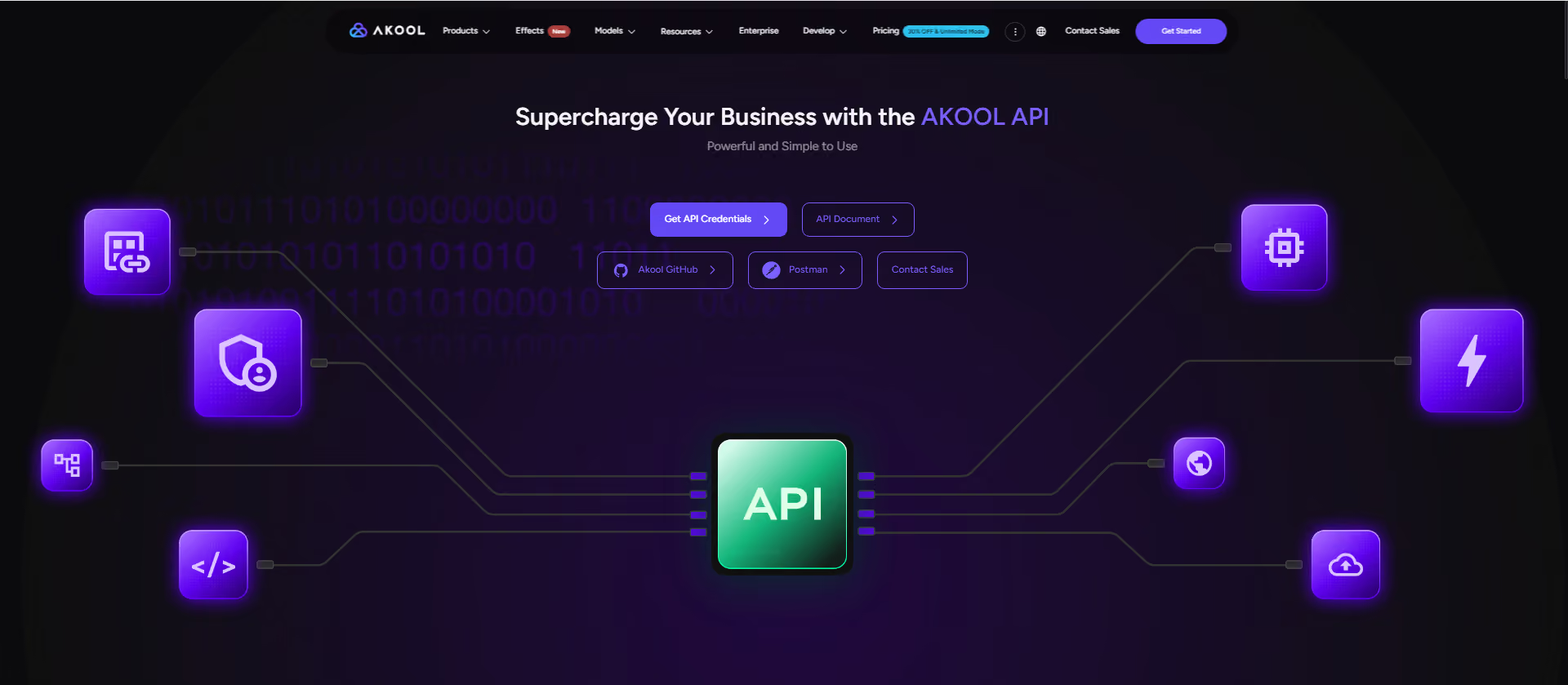
For enterprise marketing teams, the integrated workflow matters. AKOOL handles translation, dubbing, lip sync, and subtitle generation through one API rather than requiring multiple vendor relationships. This simplifies development, reduces costs, and accelerates time-to-market for multilingual campaigns.
The platform's track record with Fortune 500 brands validates its enterprise readiness. When Coca-Cola, Logitech, and Qatar Airways need video localization at scale, they choose AKOOL.
Ready to evaluate AKOOL for your multilingual content workflows? Get your API credentials and test the neural lip sync technology on your own video content.