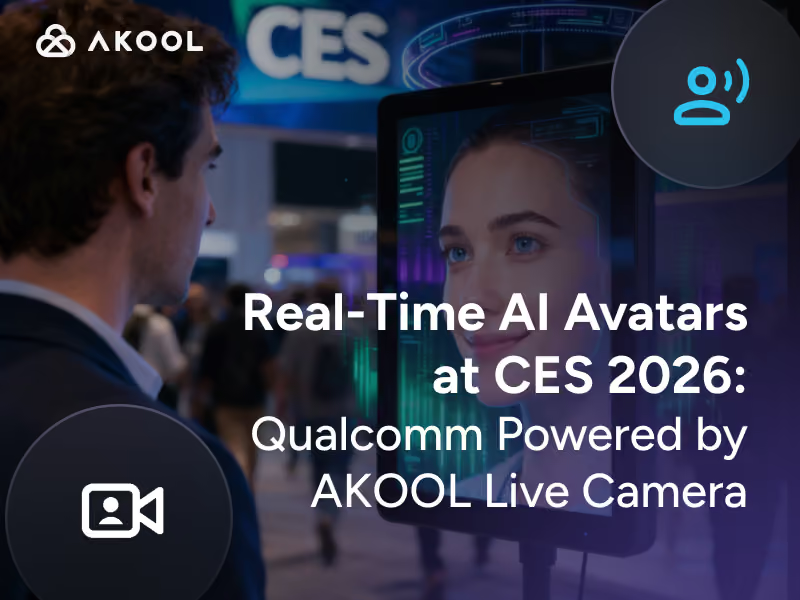

At CES 2026, Qualcomm invited attendees to step into a future where artificial intelligence is no longer tucked away behind apps, menus, and hidden interfaces—but shows up as a live, interactive presence you can engage with directly.
Under the theme “Delivering intelligence where it matters most,” Qualcomm’s booth explored how AI is increasingly distributed across the edge and the cloud, reshaping how people interact with technology across personal devices, homes, vehicles, and robotics. The message was forward-looking, but clear:
The next user interface isn’t an app or a menu, but it’s you, interacting directly with your AI agent.
To make that vision tangible, Qualcomm didn’t rely on static demos or pre-recorded videos. Instead, visitors experienced a live, real-time interactive AI avatar powered by AKOOL Live Camera, running on Qualcomm technology.
Powered by Qualcomm, brought to life by AKOOL Live Camera
Real-time AI experiences are only as compelling as they are responsive. When an AI avatar can respond instantly—naturally, fluidly, and reliably—it stops feeling like a “demo” and starts feeling like a new way to interact with technology.
That’s exactly what the Qualcomm booth showcased.
Powered by Qualcomm technology, AKOOL’s Live Camera brought real-time streaming AI avatars to life, delivering a seamless experience built around:
- On-device intelligence for responsive interaction
- Edge performance for immersive, real-time engagement
- A more natural bridge between advanced AI systems and the people using them
In other words, visitors weren’t just watching AI. They were meeting it.
From concept to live experience on the CES show floor
CES is one of the most crowded, high-energy, and competitive environments in tech. Attention is limited. Expectations are high. And demos have to earn every second of engagement.
Qualcomm wanted attendees to do more than glance at a screen—they wanted them to experience AI interaction in real time.
Using AKOOL Live Camera, Qualcomm showcased a live, streaming AI avatar that visitors could interact with directly at the booth. The avatar responded in the moment, enabling two-way conversations that felt dynamic and human rather than scripted, staged, or pre-generated.
Demonstrating the next user interface
The interactive avatar wasn’t just an attention-grabber and it was a practical demonstration of Qualcomm’s broader vision for AI: systems that don’t only compute in the background, but engage users directly.
By using AKOOL Live Camera, Qualcomm demonstrated how AI agents can:
1) Appear as a visual, conversational interface
Instead of forcing users to navigate a UI, the AI agent can show up as a face-to-face style interaction—intuitive, approachable, and instantly engaging.
2) Respond live to users in physical environments
The booth experience illustrated something critical: AI isn’t limited to screens. It can be present in real-world spaces like events, retail settings, customer experience zones, and more.
3) Act as the intelligent layer between advanced AI systems and people
As AI systems become more capable, the biggest challenge becomes usability: How do people actually interact with all that intelligence?
A real-time avatar becomes a human-facing layer that makes advanced systems feel accessible.
For attendees, the impact was immediate. Instead of hearing about “AI agents” in theory, they interacted with one.
Why real-time matters
One of the most powerful aspects of the booth experience was simple: it was live.
That might sound obvious, but it’s the difference between:
- AI that feels like a polished concept, and
- AI that feels like a usable interface
In contrast to pre-rendered avatars or delayed responses, the AKOOL-powered avatar reacted in the moment. Visitors could ask questions, observe answers immediately, and see how real-time interaction changes the way people perceive AI.
It reinforced an important idea:
For AI agents to feel useful and trustworthy, they need to operate at human speed.
When the interaction is immediate, people stop treating the AI like a novelty and start treating it like a tool—something they can actually use, in real contexts, with real expectations.
Engagement that pulled people in
On a show floor filled with competing demos and constant motion, the live avatar quickly became a point of interest at the Qualcomm booth.
Attendees didn’t just watch, and they stopped, interacted, and asked questions:
- about how the demo worked
- about what it could power next
- about where this kind of interface could be deployed in real life
And that’s where the experience became more than a CES moment. It became a bridge between cutting-edge AI infrastructure and practical, real-world applications.
Many visitors could easily imagine this kind of interface being used across:
- Events and exhibitions (interactive hosts, guides, explainers)
- Customer engagement and brand experiences (conversational product education)
- Smart devices and intelligent environments (more natural AI interaction at the edge)
- AI agents embedded into everyday workflows (a human-facing interface for complex systems)
The demo made the future feel less abstract and more actionable.
A glimpse into the future of AI interaction
Qualcomm’s CES 2026 booth pointed to a clear direction for AI: intelligence that is distributed, responsive, and human-facing.
By live-demoing an interactive avatar using AKOOL Live Camera, Qualcomm showed how AI agents can move beyond screens and into real conversations serving as intuitive interfaces for systems that span edge and cloud.